ASME B16.9 elbow dimensions explained: LR, SR, angles and tolerances
How ASME B16.9 elbow dimensions are derived, why long radius centre-to-end equals 1.5 x NPS, how to read the tolerance table and how to specify 3D and 5D bends for piggable lines.
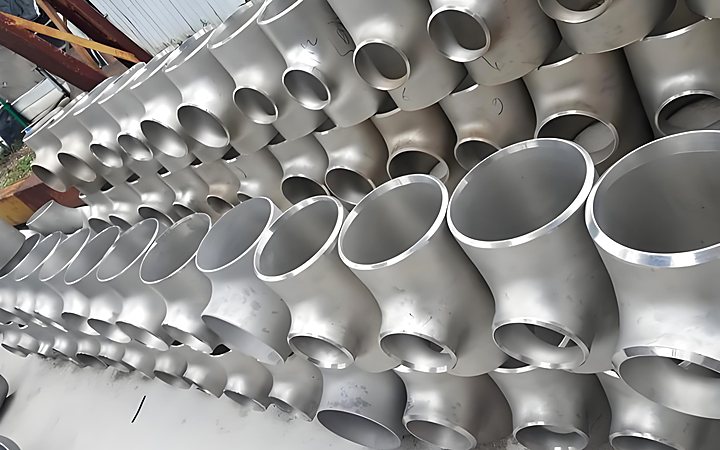
Elbows held in stock across the standard size range.
Long radius, short radius and why it matters
Long radius elbows, R = 1.5D, are the default for process piping because they impose a lower pressure drop and lower local velocities, which reduces erosion and slurry wear. Short radius elbows, R = 1.0D, fit into tight spaces but roughly double the pressure drop of an equivalent long radius bend and increase erosion dramatically in abrasive or two-phase flow.
Welding either type is straightforward since dimensions match the pipe bore, but designers must remember that short radius elbows are also harder to pig and generally avoided on piggable lines.
Deriving centre-to-end yourself
For a 90° elbow the centre-to-end dimension A equals the radius itself, so A (mm) = 1.5 x NPS (inches) x 25.4 for long radius and NPS x 25.4 for short radius. For a 45° elbow the centre-to-end B is the tangent projection: B = R x tan(θ/2) = 0.4142 x R, giving roughly 41 % of the equivalent 90° dimension.
Worked values for common sizes
NPS
DN
OD (mm)
90° LR A (mm)
90° SR A (mm)
45° LR B (mm, approx.)
2
50
60.3
76
51
32
4
100
114.3
152
102
64
6
150
168.3
229
152
95
10
250
273.0
381
254
158
12
300
323.9
457
305
189
Reading the ASME B16.9 tolerance table
B16.9 tolerances grow with size because holding precision on a DN1200 fitting is far harder than on DN25. The four critical columns are outside diameter at the bevel, inside diameter at the ends, off angle Q and off plane P.
ASME B16.9 general tolerances (mm)
NPS
DN
O.D. at bevel
I.D. at end
Off angle Q
Off plane P
½ – 2½
15 – 65
+1.6 / -0.8
±0.8
±1
±2
3 – 4
80 – 100
±1.6
±1.6
±2 to ±3
±4 to ±5
5 – 8
125 – 200
+2.4 / -1.6
±1.6
±3
±6
10 – 18
250 – 450
+4.0 / -3.2
±3.2
±4
±10
20 – 24
500 – 600
+6.4 / -4.8
±4.8
±5
±10
32 – 48
800 – 1200
+6.4 / -4.8
±4.8
±5
±19
Note that these tolerances do not apply in localised formed areas where increased wall thickness is required to meet design requirements, so always check the specific clause against your fitting type.
Wall thinning at the extrados
When pipe is bent, the outer wall - the extrados - thins and the inner wall - the intrados - thickens. Purchasers sometimes specify a minimum extrados thickness after forming. Discuss this before manufacture because the starting pipe schedule may have to be increased to satisfy it, affecting weight and cost.
3D, 5D and induction bends for piggable lines
Long radius bends of 3D, 5D and above are produced for pipelines that must be pigged or where pressure drop and erosion must be minimised. Specify the radius, angle, tangent length, ovality limit, maximum wall thinning and whether the bend will be induction bent from line pipe. Hangbo supplies these to drawing with full dimensional reporting.
What to put on the purchase requisition
Dimensional standard: ASME B16.9, or MSS SP-43 for Schedule 5S and 10S light wall.
Material specification: ASTM B366, B363, A815 or A403 plus explicit UNS or grade.
Angle and radius: 90° LR, 45° LR, 90° SR, 180° return or special 3D / 5D.
NPS or DN plus schedule or actual wall thickness.
End preparation to ASME B16.25 and any special bevel requirement.
Certification: EN 10204 3.1 minimum, plus NDT scope and any PMI requirement.
Questions about this topic
What is the centre-to-end dimension of a 6 inch long radius 90 degree elbow?
229 mm. It equals 1.5 x 6 inches x 25.4, giving 228.6 mm which the ASME B16.9 table rounds to 229 mm. The short radius equivalent is 152 mm.
Are the tolerances the same for seamless and welded fittings?
Yes, ASME B16.9 applies the same dimensional tolerances to both, provided welded fittings meet the stated weld quality and radiography requirements of the material specification.
Can I use MSS SP-43 fittings in ASME B31.3 piping?
Yes for light wall Schedule 5S and 10S corrosion resistant piping where the design temperature and pressure fall within the calculated allowable stress, but many operators restrict them to non-critical utility services.
What wall thickness should I specify for high pressure lines?
Specify actual wall thickness rather than schedule when the design is close to limits, and always check that the fitting schedule matches the pipe schedule so the bore is continuous and there is no internal step at the weld.
How do I measure off plane P?
Place the fitting on a surface plate and measure the maximum deviation of the free end face from the plane formed by the other two end faces. It is a common cause of misalignment during field welding, particularly on large diameter elbows.
Questions about our products
What products does Hangbo Alloy supply?
Four product families, all available in nickel-based alloys, titanium, duplex and special stainless steel: flanges, butt weld pipe fittings, elbows, and seamless tube and pipe. Flanges cover weld neck, long weld neck, slip-on, blind, socket weld, threaded and lap joint patterns. Fittings and elbows cover concentric and eccentric reducers, equal and reducing tees, caps, stub ends, and 45°, 90° and 180° returns in both long and short radius, plus 3D and 5D bends for piggable lines. Seamless tube and pipe is supplied cold drawn or hot finished from 6 mm to 630 mm outside diameter.
Which alloy grades are available for these products?
More than 90 grades are published in our grade library. The most requested are Inconel 625, 718, 600 and X-750, Hastelloy C-276, C-22 and B-2, Monel 400 and K-500, Incoloy 800H, 825 and 925, duplex 2205 and super duplex 2507, 316L, 904L and 254SMO stainless steel, and titanium Grade 2 and Grade 5. Nickel-based grades can also be supplied with VIM plus ESR double melting where cleanliness or fatigue life is critical.
What sizes, wall thicknesses and pressure classes can you supply?
Flanges run from NPS ½ to NPS 24 to ASME B16.5 and from NPS 26 to NPS 60 to ASME B16.47 Series A or B, in pressure classes 150 through 2500. Butt weld fittings and elbows run from NPS ½ to NPS 48 (DN 15 to DN 1200) in wall thickness Schedule 5S through XXS. Seamless tube and pipe covers 6 mm to 630 mm outside diameter, in random lengths of about 5 to 7 metres or fixed lengths up to 12 metres. Non-standard and intermediate sizes are quoted on request.
Which material and dimensional standards do you work to?
Forged flanges to ASTM B564, B381 and A182 with dimensions to ASME B16.5 and ASME B16.47. Butt weld fittings and elbows to ASTM B366 and A403 with dimensions to ASME B16.9 and MSS SP-43. Seamless tube and pipe to ASTM B444, B423, B622, B163, B167, B861, A312, A213 and A790. Marking follows MSS SP-25 and the applicable product standard. If your project is governed by EN, DIN, JIS or a company specification, send the document and we will confirm equivalence before quoting.
Is there a minimum order quantity?
There is no minimum for standard sizes and grades held in stock, and prototypes, spares and small trial batches are accepted. Made-to-order melts and special forgings carry a minimum weight that depends on the alloy and the route, typically from about 500 kg for special grades.
What inspection and certification is issued with the goods?
Every shipment carries an EN 10204 3.1 mill test certificate quoting the actual chemical and mechanical results for the specific heat lot, together with dimensional records and heat treatment data where applicable. Testing is carried out in house by optical emission spectrometry, tensile, impact and hardness testing, plus ultrasonic and eddy current examination, with hydrostatic pressure and intergranular corrosion testing to ASTM G28 or A262 Practice E where the specification requires it. Third party inspection by SGS or another recognised agency can be arranged, and their report is issued alongside the shipment.
What are typical lead times?
Standard stock items ship within days. Common production grades such as Inconel 625 or duplex 2205 are typically a few weeks. Special chemistries, larger forgings and items that require third party inspection take longer and are quoted individually against the requirement.
How are the products packed for export?
Flanges and fittings receive a rust preventive coating, are individually wrapped and are packed in plywood cases secured with steel banding. Tube ends are capped and bundles are strapped. Packing lists quote heat numbers so every case can be cross-checked against the mill certificate on arrival. We quote EXW, FOB, CFR, CIF and DAP, and mixed-alloy orders can be consolidated into one shipment with a single documentation package.
How do I request a quotation or a sample?
Send the grade or UNS number, the dimensions including schedule or wall thickness, the governing material and dimensional standards, quantity, any heat treatment or NDT scope and the certificate type you need; a drawing is ideal for special flanges and fittings. Email demi@nickel-alloy.com or message us on WhatsApp +86 15618279078 and we normally issue a formal quotation within 24 hours on working days. Samples and previous test reports can be arranged before the first order.
HA
Written by Hangbo Alloy Technical Team
Metallurgy & materials engineering. Reviewed against the latest ASTM, ASME and AMS specifications held on file at Hangbo Alloy. Last updated 2026-09-18.
Send us your drawing, material specification and quantity. You receive a formal quotation within 24 hours, including melting route, heat treatment, testing scope and certificate format.