Special alloy manufacturer & exporter · Shanghai, China

demi@nickel-alloy.com  |  +86 15618279078  |  WhatsApp

Technical knowledge

Inconel 718 flanges and bolting: strength, hardness limits and sour service

Inconel 718 flanges and bolting to UNS N07718: age hardening response, strength versus 625, NACE MR0175 hardness limits, galling control and when 718 is the correct choice.
Published Last updated 8 minute readCategory: Technical knowledge
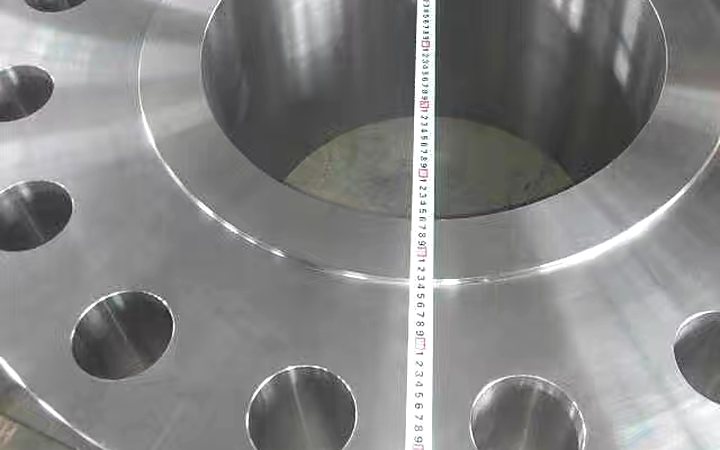
Close view of drilled bolt holes on a nickel alloy flange machined for high pressure service
Bolt hole circle and machined sealing face on a high strength nickel alloy flange.

What makes 718 different from 625

Inconel 625 is strengthened by molybdenum and niobium in solid solution. Inconel 718 is strengthened by gamma prime and gamma double prime precipitates formed during a two stage age hardening cycle. That single difference explains every trade off: 718 reaches roughly two and a half times the yield strength of annealed 625, but its corrosion resistance depends on the thermal history and it must be aged within a controlled window.

Inconel 625 versus Inconel 718 for flanges and bolting
Property625, annealed718, aged
Typical yield strength414 MPa minimum1034 MPa minimum
Typical tensile strength827 MPa minimum1276 MPa minimum
Typical PREN45 - 51About 30
Usable temperatureTo about 650 C in oxidising serviceTo about 650 C, strength limited above
Sour serviceAnnealed condition, listedAged condition, hardness controlled
WeldabilityExcellent, no ageing neededGood, but the HAZ needs a post weld age

The heat treatment window decides the properties

A 718 flange is only as good as its thermal cycle. The widely used sequence is solution annealing followed by a two step age, typically around 720 C then 620 C. Skipping the solution step, or ageing from a heavily worked structure, produces a coarse grain and a low creep rupture life that no amount of testing will reveal until it is too late.

Tip Ask for the heat treatment chart with the certificate. A chart showing furnace load, set point, soak time and quench medium is far more informative than a certificate line that simply says aged.

Bolting, galling and hardness control

Inconel 718 is the default choice for high strength bolting in severe service, supplied to ASTM B637 or to the fastener specification appropriate to the project. Two practical problems recur in the field.

  • Galling. Nickel alloy threads seize under load. Specify a compatible anti-seize compound, control thread fit, and consider a surface treatment on nuts.
  • Hardness. For sour service to NACE MR0175 / ISO 15156, 718 must be supplied in the aged condition with hardness typically limited to 40 HRC or the project specified maximum. State the limit on the order and require the actual value on the certificate.

When to choose 718 and when to stay with 625

Choose 718 when the joint is strength or relaxation limited: high pressure wellhead and christmas tree connections, high temperature bolting that must hold preload through thermal cycles, compact flanges where space dictates a smaller section, or springs and retainers in the same alloy family. Stay with 625 when the dominant risk is pitting, crevice corrosion or stress corrosion cracking, because 625 has a higher PREN and is not sensitive to the ageing cycle.

Questions about this topic

Is Inconel 718 magnetic?
In the aged condition 718 is essentially non-magnetic, which is one reason it is used for downhole and instrument components. Cold work can introduce slight magnetic response, so do not use a magnet as a sorting test.
Can 718 flanges be welded to 625 pipe?
Yes, and it is common on wellhead assemblies. Use ERNiFeCr-2 or ERNiCrMo-3 depending on the design, and apply the post weld age required for 718 so the joint reaches specified strength. Confirm the cycle with the welding engineer because an over-age will soften the 718 side.
What hardness limit applies for sour service?
NACE MR0175 / ISO 15156 lists Inconel 718 in the aged condition with a maximum hardness, commonly applied as 40 HRC. The applicable limit depends on the edition and the environmental severity, so quote the edition in the purchase order and require actual hardness readings on the certificate.

Questions about our products

What products does Hangbo Alloy supply?
Four product families, all available in nickel-based alloys, titanium, duplex and special stainless steel: flanges, butt weld pipe fittings, elbows, and seamless tube and pipe. Flanges cover weld neck, long weld neck, slip-on, blind, socket weld, threaded and lap joint patterns. Fittings and elbows cover concentric and eccentric reducers, equal and reducing tees, caps, stub ends, and 45°, 90° and 180° returns in both long and short radius, plus 3D and 5D bends for piggable lines. Seamless tube and pipe is supplied cold drawn or hot finished from 6 mm to 630 mm outside diameter.
Which alloy grades are available for these products?
More than 90 grades are published in our grade library. The most requested are Inconel 625, 718, 600 and X-750, Hastelloy C-276, C-22 and B-2, Monel 400 and K-500, Incoloy 800H, 825 and 925, duplex 2205 and super duplex 2507, 316L, 904L and 254SMO stainless steel, and titanium Grade 2 and Grade 5. Nickel-based grades can also be supplied with VIM plus ESR double melting where cleanliness or fatigue life is critical.
What sizes, wall thicknesses and pressure classes can you supply?
Flanges run from NPS ½ to NPS 24 to ASME B16.5 and from NPS 26 to NPS 60 to ASME B16.47 Series A or B, in pressure classes 150 through 2500. Butt weld fittings and elbows run from NPS ½ to NPS 48 (DN 15 to DN 1200) in wall thickness Schedule 5S through XXS. Seamless tube and pipe covers 6 mm to 630 mm outside diameter, in random lengths of about 5 to 7 metres or fixed lengths up to 12 metres. Non-standard and intermediate sizes are quoted on request.
Which material and dimensional standards do you work to?
Forged flanges to ASTM B564, B381 and A182 with dimensions to ASME B16.5 and ASME B16.47. Butt weld fittings and elbows to ASTM B366 and A403 with dimensions to ASME B16.9 and MSS SP-43. Seamless tube and pipe to ASTM B444, B423, B622, B163, B167, B861, A312, A213 and A790. Marking follows MSS SP-25 and the applicable product standard. If your project is governed by EN, DIN, JIS or a company specification, send the document and we will confirm equivalence before quoting.
Is there a minimum order quantity?
There is no minimum for standard sizes and grades held in stock, and prototypes, spares and small trial batches are accepted. Made-to-order melts and special forgings carry a minimum weight that depends on the alloy and the route, typically from about 500 kg for special grades.
What inspection and certification is issued with the goods?
Every shipment carries an EN 10204 3.1 mill test certificate quoting the actual chemical and mechanical results for the specific heat lot, together with dimensional records and heat treatment data where applicable. Testing is carried out in house by optical emission spectrometry, tensile, impact and hardness testing, plus ultrasonic and eddy current examination, with hydrostatic pressure and intergranular corrosion testing to ASTM G28 or A262 Practice E where the specification requires it. Third party inspection by SGS or another recognised agency can be arranged, and their report is issued alongside the shipment.
What are typical lead times?
Standard stock items ship within days. Common production grades such as Inconel 625 or duplex 2205 are typically a few weeks. Special chemistries, larger forgings and items that require third party inspection take longer and are quoted individually against the requirement.
How are the products packed for export?
Flanges and fittings receive a rust preventive coating, are individually wrapped and are packed in plywood cases secured with steel banding. Tube ends are capped and bundles are strapped. Packing lists quote heat numbers so every case can be cross-checked against the mill certificate on arrival. We quote EXW, FOB, CFR, CIF and DAP, and mixed-alloy orders can be consolidated into one shipment with a single documentation package.
How do I request a quotation or a sample?
Send the grade or UNS number, the dimensions including schedule or wall thickness, the governing material and dimensional standards, quantity, any heat treatment or NDT scope and the certificate type you need; a drawing is ideal for special flanges and fittings. Email demi@nickel-alloy.com or message us on WhatsApp +86 15618279078 and we normally issue a formal quotation within 24 hours on working days. Samples and previous test reports can be arranged before the first order.

Written by Hangbo Alloy Technical Team

Metallurgy & materials engineering. Reviewed against the latest ASTM, ASME and AMS specifications held on file at Hangbo Alloy. Last updated 2026-09-18.

Questions on this specification? Email demi@nickel-alloy.com or WhatsApp +86 15618279078.

Continue reading

Ready to specify your alloy?

Send us your drawing, material specification and quantity. You receive a formal quotation within 24 hours, including melting route, heat treatment, testing scope and certificate format.